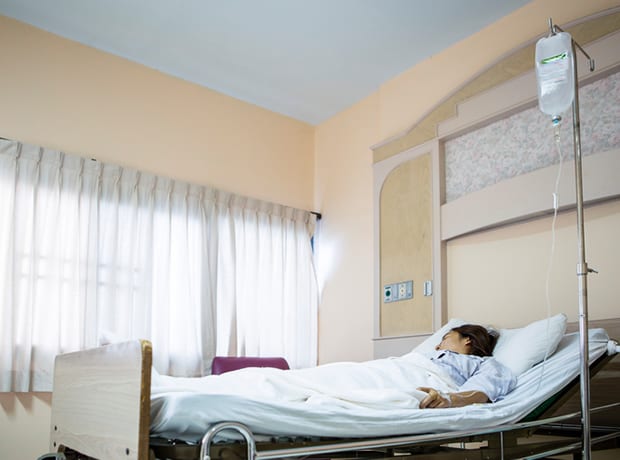
Amid celebrations of the NHS’ 70th birthday two months ago, the united concerns voiced by healthcare professionals resonated across the nation. Struggles for the industry have been far from secret; patients across the UK felt the longer waiting times in doctors’ offices and the higher bed occupancy levels in hospitals. Underinvestment in mental health services has seen waiting lists grow to almost a year long, causing a staggering three-quarters of young referrals to deteriorate while they wait.
The NHS has experienced some firsts lately. The summer heatwave saw frontline staff struggle to cope with record A&E attendances; cancer treatment waiting times have grown to their worst ever level; and 999 calls climbed to a record-high ten million. A heavily ageing – and expanding – population is only scheduled to drain services further as demands are expected to increase annually by 6%.
As cuts to funding ravish care homes, more and more elderly people are falling or becoming trapped alone in their own home. Emergency services are stretched thin with priority going to callers in life-threatening conditions. The Times discovered more than half of patients forced to wait overnight for an ambulance were over the age of 70. The growing number of over 85s requiring 24-hour care is estimated to double to almost half a million by 2035. The current workforce is not equipped to handle such a scale.
These are the casualties of a severe staffing crisis. Staff work tirelessly round the clock, on their feet, covering overtime shifts and filling in rota gaps. However, Brexit threatens to exacerbate these shortages. Even worse, a no-deal Brexit will deepen workforce woes for the remaining staff at a time when the NHS can’t afford to get much worse.
The Royal College of General Practitioners (RCGP) warned the ‘hostile environment’ coupled with the Windrush fiasco has only aggravated matters for the industry. Not only were international migrants discouraged from a healthcare career in the UK, but the Home Office were literally rejecting thousands of applicants in a bid to reach net migration targets.
Speaking out against the Tier 2 Work Visa cap that sits at 20,700 per year, NHS officials claimed the cap contributed to staff shortages and rota gaps which had a knock-on effect for patients. Once it was revealed that 2,500 international healthcare professionals were turned away, the Home Office attempted to rectify the damage: they announced in June that doctors and nurses applying from overseas will no longer be subjected to the cap.
However, the months following the cap relief have been disheartening for the industry. Staffing shortages continue to plummet at an alarming rate. The Royal College of Nursing (RCN) claim nursing vacancies have risen by 17% in the last three months. Data by NHS Improvement showed nurse posts are in shortage of 42,000 workers and 9.3% of doctor posts are also currently vacant, facing a shortage of 11,500. In a no-deal Brexit scenario, care workers are expected to be in demand of 350,000 to 1.1 million workers. One care worker could be forced to juggle 14 care-dependent peoples at any one time which is double the current ratio of seven for every one carer.
The NHS is in the midst of its worst crisis to date. Shortages of workers are now so dire that thinktanks claim it’s at risk of becoming a “national emergency”.
Brexit is just over six months away, yet the UK government have done little to squash legitimate fears. The collateral damage of the government’s incompetence has been the loss of healthcare workers who are rapidly leaving the industry. It’s no surprise that thousands are hanging up their uniforms for a job with more rewarding pay and significantly less stress. International and European workers are looking further afield, reluctant to stay put in the UK when the future holds uncertainty and instability.
The Confederation of British Industry (CBI) released its report – Open and Controlled: A New Approach to Immigration After Brexit – last month to highlight 18 key industries that are in jeopardy due to Brexit. The report revealed far fewer EU workers are taking up a medical career in the UK than the current rate of staff leaving. Near 10,000 EU NHS workers had left their positions by 2017 – a year after the referendum result. The Nursing and Midwifery Council reported a dramatic 89% decreased in EU nurses since 2016: only 805 nurses and midwives joined in 2017 than the 6,382 who joined the year before. The Department of Health and Social Care (DHSC) found two thousand mental health staff are leaving their positions a month in the NHS.
Although current EU workers have been granted security in the UK under ‘Settled Status’, recruiters are worried for what the future holds past the implementation period. Since the UK government have absconded from implementing an immigration alternative, speculation surrounding a no-deal (and bad deal) Brexit have many believing that the current immigration system in place will extend to include Europeans once Free Movement has ended.
However, this would be disastrous to the industry. The NHS depends on its EU workers. According to the CBI, EU nationals make up 17% of dentists, 10% of doctors and 7% of social care workers, physiotherapists and nurses. Every one in 20 care workers in the UK are from Europe.
Although doctors and nurses are exempt from the Tier 2 Visa cap, the UK’s healthcare shortages aren’t limited to these two professions. Under the current immigration system, professionals such as pharmacists, home care assistants, psychiatrists, orthotists, prosthetists, care workers, radiographers and medical practitioners will still fall victim to the cap. Medical workers and researchers will be up against other leading UK industries that also have staffing shortages. Engineers, musicians, farmers, educators, HGV drivers and hospitality staff are just a handful of examples of those that will be competing for a visa before the limit is reached. The technology sector alone estimates it will require to fill 1.5 million new technology jobs by 2030 which clearly can’t be reached with the cap in place.
As our world evolves, the demand for expertise found further afield will rise. It won’t be uncommon for employers to fund their applicants’ visa costs to offer a competitive edge, yet medical staff won’t have this privilege. The UK government does offer reduced visa fees for those applying on the Shortage Occupation List, but even nurses and doctors will have to pay up to £1,000 per visa – even with the discount.
The CBI suggest an alternative method to save the NHS: encourage homegrown and local talent. However, recent initiatives to leverage numbers have been fruitless. The Royal College of Midwives (RCM) claim the larger numbers of workers leaving the service than those joining “almost cancel each other out” since the sector loses 29 midwives for every 30 trained.
The Home Office plans to increase the number of training places for doctors, nurses and midwives by 25% in the forthcoming years. However, the sudden shortfalls imposed by a no-deal Brexit would be too wide for the industry to quickly bounce back to. Not to mention that many British youngsters are discouraged from studying a medical course: applications to study nursing have fallen by a third since the government scrapped bursaries in 2017. Although the government laid preference to students in its White Paper document, EU students will undoubtedly consider other places to study than the UK. The ‘best and brightest’ are most likely to opt for a medical degree closer to home that offers a lot less debt as well as job prospects post-graduation.
To overcome a potential ‘cliff edge’ for the sector, a lot more needs to be done. The vacancy gap is extending to a point beyond repair, and we can’t rely on UK talent alone. The CBI put forth 14 policy recommendations to the government in a bid to steer Brexit negotiations. In this initiative, not only do they seek the removal of the cap, but they call for the complete upheaval of the Tier 2 Visa. Not only would medical staff be subjected to the cap, but EU workers who are equally as integral to the NHS perform in “behind the scenes” roles. General maintenance and on-site café workers as well as clinical assistants and lab technicians would fail to meet the stringent Tier 2 Visa requirements, meaning they would not be permitted to work in the UK at all.
It is vital that the UK government relaxes its rules. International and European migrants with diverse skill levels and capabilities must be allowed to work in the UK and urgently aid the NHS. Without an upheaval or amended immigration plan, the NHS’ chances of survival are dimming by the day.
Olivia Bridge is a specialist content writer and political correspondent for the Immigration Advice Service and leading Immigration Lawyers UK