A study led by researchers from the Institute of Cancer Research (ICR) and the Royal Marden NHS Foundation Trust has revealed a new tool that can predict the recurrence of prostate cancer more than a decade ahead.
Published in Nature Cancer, the study was supported by funding from Cancer Research UK, the Medical Research Council and the Wellcome Trust.
Prostate cancer is the most commonly diagnosed cancer in men in the UK, with about one in eight men diagnosed in their lifetime, leading to more than 12,000 deaths each year.
Using machine learning, researchers analysed 1,923 samples from 250 participants on the intensity modulated radiotherapy (IMRT) clinical trial, as well as assessed the genetic differences between the cells within individual tumours, using 642 samples from 114 participants in radiotherapy trials at the Royal Marsden, to provide integrated information about the cells’ genomics and morphology, along with the patients’ outcomes over more than a decade.
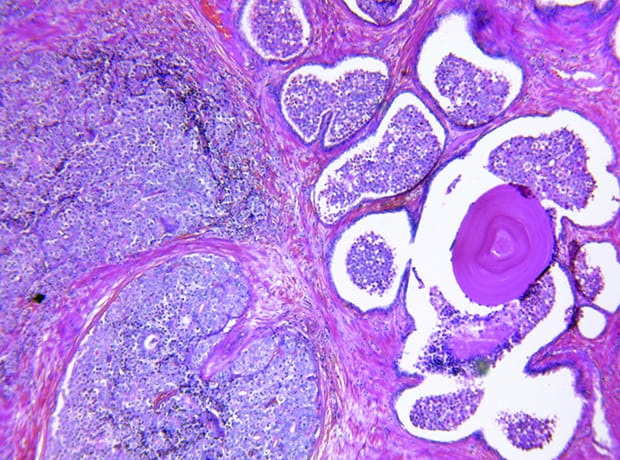
The study found genetic divergence and artificial intelligence-measured morphological diversity indicated the tumour’s ability to evolve to allow the disease to adapt and survive.
After measuring this diversity by looking at the extent of the differences between cells in different areas of the tumour using intra-tumour heterogeneity, the team found that this ‘evolvability’ was a strong predictor of recurrence, with the combination of the two measurements identifying a subgroup of patients who experienced disease recurrence in 50% less time compared with the rest of the patients.
Furthermore, researchers identified a correlation between the loss of a specific chromosome and a reduced presence of immune cells in the tumour, which could affect its response to certain treatments.
Professor David Dearnaley, emeritus professor, ICR, commented: “We believe that our findings will make it possible to identify the patients with high-risk localised cancer who are most likely to benefit from early treatment with life-extending medications.”
Researchers intend to test their evolution-based measurements of recurrence risk in a larger group of people with a broader range of disease characteristics.